
This strategy saved a couple $80,000. From 2027, it could backfire.
Recently, I worked with a couple approaching retirement who owned an investment property in Sydney.
By carefully coordinating the sale of their property with sizeable tax-deductible super contributions, we reduced their capital gains tax by approximately $80,000.
It was a great outcome.
And it’s exactly the type of strategy we’ll need to be much more careful with from 1 July 2027.
The strategy that has worked so well
For years, one of the most effective retirement tax strategies has been to sell an investment after work finished when taxable income is lower, and combine the sale with a deductible super contribution.
The contribution reduces taxable income and can significantly reduce the tax payable on a capital gain.
For the Sydney couple, it worked beautifully.
But the new minimum 30% tax on certain capital gains changes the equation.
From 1 July 2027, a deductible super contribution can still reduce taxable income, but it does not necessarily reduce the capital gain used to calculate the new 30% minimum tax.
That creates a potential trap.
The size of the gain matters
This doesn’t mean deductible super contributions suddenly stop being useful.
The outcome can look completely different depending on the size of the gain.
For these simplified examples, assume the retiree:
has no other taxable income
has the full $32,500 concessional cap available and eligible to contribute it to super
makes a $32,500 deductible personal super contribution
has made no other concessional contributions during the year
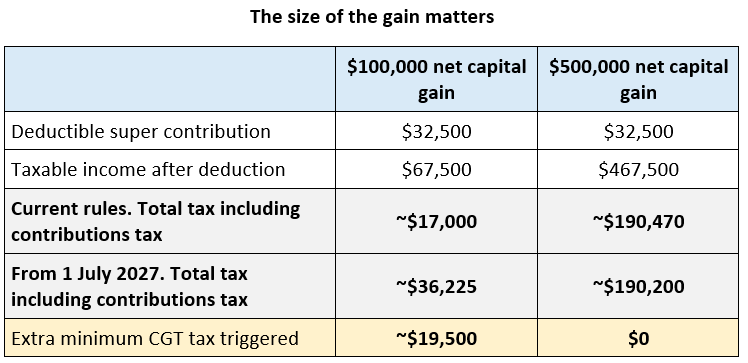
Simplified examples include the 2% Medicare levy and 15% contributions tax. They exclude offsets, Division 293 tax and other individual circumstances
Look at the difference.
With the $100,000 gain, the deductible contribution reduces taxable income to $67,500, but the new minimum 30% tax still applies.
In fact, under the new rules, making the $32,500 contribution could leave this retiree around $4,225 worse off than making no deductible contribution at all.
Now look at the $500,000 gain.
At that level, the person’s ordinary tax is already above the new 30% minimum, so there is no additional minimum CGT tax.
The same $32,500 deductible contribution could still save them approximately $10,400, after allowing for contributions tax.
That’s the important point.
There won’t be a simple rule that deductible super contributions no longer work after 1 July 2027.
For someone with a more modest capital gain and little other taxable income, the strategy could potentially backfire.
For someone realising a very large capital gain, the same strategy may still be extremely valuable.
The numbers need to be modelled before the asset is sold and before the contribution is made.
The “$1 Age Pension” twist
There’s another part of the new rules that makes timing even more interesting.
I’ve joked for years that when I reach Age Pension age, I might spend a lot of effort trying to qualify for just $1 of Age Pension.
There could now be an even bigger reason.
If someone receives the Age Pension at any time during the financial year in which they realise the relevant capital gain, the minimum 30% CGT rule doesn’t apply.
It doesn’t make the gain tax-free. It simply removes the 30% minimum and allows the normal tax rules to apply.
And it’s not only the Age Pension.
The exemption also extends to a range of qualifying government payments, including JobSeeker, Disability Support Pension, Carer Payment, Parenting Payment, Family Tax Benefit and certain veterans’ payments.
That could create some very interesting planning opportunities.
But there’s a big catch
A large capital gain could itself reduce or completely wipe out entitlement to some government benefits.
Family Tax Benefit is a good example. A capital gain can increase adjusted taxable income and potentially reduce or eliminate the benefit.
Age Pension works differently, but asset values, ownership and what happens to the sale proceeds can all affect Centrelink’s means tests.
So this isn’t about chasing $1 from Centrelink simply to save tax.
It’s about looking at the total outcome.
Tax. Super. Centrelink. And timing.
Why we’re rethinking when retirees sell
For some retirees, selling an investment property or large share portfolio immediately after finishing work may still be the best strategy.
For others, we may increasingly model whether holding the asset for longer produces a better after-tax result.
That could mean asking:
Could selling at 67 produce a better outcome than selling at 60?
Not because everyone should wait for the Age Pension.
But because the timing of a major asset sale could potentially be worth tens of thousands of dollars.
The Sydney couple we recently helped saved approximately $80,000 by getting the timing and super strategy right.
The rules are changing, but the lesson isn’t.
Sometimes the most valuable advice isn’t what to sell.
It’s knowing when to sell it.
If you hold a large share or property portfolio personally, particularly with significant unrealised capital gains, and are considering selling, get in touch with us before you sell. Getting the strategy right beforehand could make a significant difference to the tax you ultimately pay.
Disclaimer: This article contains general information only and includes simplified examples. It does not constitute financial, taxation or legal advice. Outcomes depend on individual circumstances, including tax, superannuation and social security rules. Seek professional advice before making financial decisions.