
How one couple made their retirement money work harder without taking more investment risk
At a recent retirement planning meeting, I recommended something that surprised my clients.
Spend more on upgrading your retirement home when they move to the coast.
They looked at me as though that was the opposite of what a financial adviser should be telling them.
But once we ran the numbers, it made sense.
Their retirement dilemma
The couple had around $1.4 million in assessable assets, including super.
One had already retired and the other planned to finish work next year. They wanted to travel, move closer to the coast and enjoy retirement while they were still healthy enough to make the most of it.
But they also had some very normal concerns.
Would their money last?
What happens if markets fall just after they retire?
Could the surviving spouse still live comfortably if one of them died?
And could they qualify for at least a part Age Pension from age 67, along with the valuable Pensioner Concession Card?
Under their existing strategy, they were likely to receive little or no Age Pension for quite some time.
So we looked at things differently.
My first recommendation: spend more on the house
Rather than buying a cheaper retirement home and leaving more money invested, we modelled increasing their housing budget.
Why?
Because the family home is generally exempt from Centrelink's Age Pension assets test.
That meant they could potentially buy the home they really wanted, improve their lifestyle and reduce the assets counted by Centrelink.
Of course, spending more on a house means there is less money left producing retirement income.
So that created the next problem.
How do we make the remaining money last?
We didn't want to simply increase investment risk and hope for higher returns.
Instead, we looked at changing how their retirement income was built.
Part of their super would remain in an account-based pension, giving them flexibility, liquidity and exposure to investment markets.
Another portion would be allocated to a qualifying lifetime income stream, with income designed to continue for the surviving spouse.
This gave them another source of retirement income that wasn't dependent on what the sharemarket happened to be doing that year.
Qualifying lifetime income streams can also receive more favourable Centrelink means-test treatment than simply leaving the same amount in an ordinary account-based pension.
That's where the pieces started coming together.
With and without the annuity AFTER spending $250k on upgrading home. This brought forward Age Pension eligibility from age 73 to age 67.
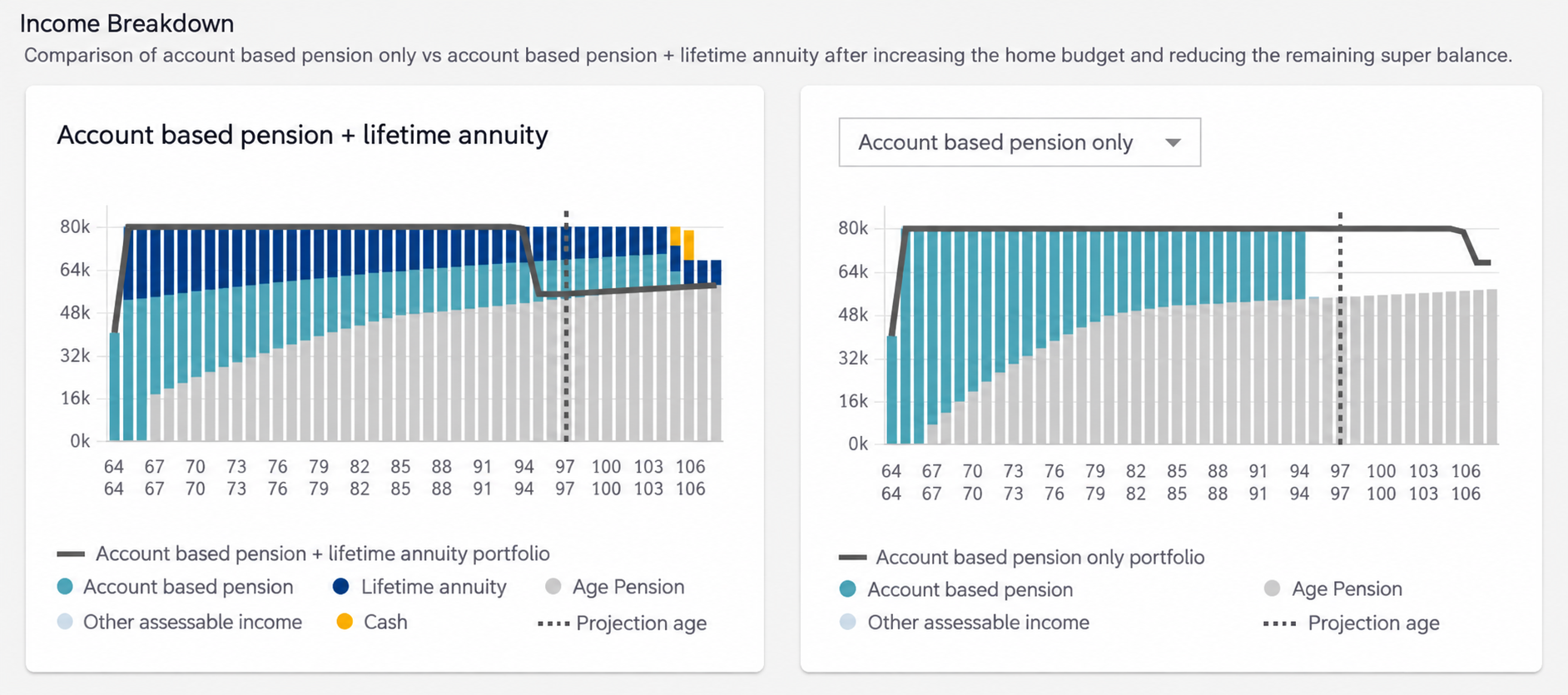
With and without the annuity AFTER spending $250k on upgrading the retirement home. This brought forward their Age Pension eligibility from age 73 to age 67, as well as increasing their Age Pension.
One strategy. Multiple problems solved.
The strategy potentially allowed them to:
buy a better long-term retirement home
improve their chances of qualifying for a part Age Pension earlier
access Pensioner Concession Card benefits
reduce reliance on investment markets for all of their income
provide greater income certainty for the surviving spouse
keep part of their super invested for growth and flexibility
Importantly, we weren't replacing investing.
We were combining different tools for different jobs.
The account-based pension provides flexibility and growth potential.
The lifetime income stream provides another layer of income certainty.
The family home supports the lifestyle they actually want to enjoy.
And the increased Age Pension received means less money needs to be drawn from their own retirement savings.
Retirement isn't just about getting the highest return
This is something I think retirees sometimes overlook.
Building wealth and spending wealth are two very different financial challenges.
Before retirement, the focus is often on growth.
Once you retire, the questions change.
How much can I safely spend?
What happens if markets fall?
What happens if I live longer than expected?
And what happens financially if my partner dies before me?
The investment portfolio with the highest projected return isn't automatically the best retirement strategy.
Sometimes accepting a different mix of growth, flexibility and guaranteed lifetime income can produce a better overall outcome.
The real goal
For this couple, the answer wasn't taking more investment risk.
It was redesigning their finances so they could spend more on the home they wanted, improve the sustainability of their retirement income and feel more confident about the future.
That's what good retirement planning should ultimately achieve.
Not just helping you make more money.
Helping you feel confident enough to enjoy the money you've already built.
If you're approaching retirement with significant super and investments and wondering how much you can safely spend, get in touch.
Retirement income planning is about much more than choosing investments.
Disclaimer: This case study has been simplified and anonymised for illustrative purposes. The strategies discussed may not be suitable for everyone and depend on individual circumstances, including age, assets, income needs, product features and Centrelink eligibility. This article contains general information only and does not constitute personal financial advice.